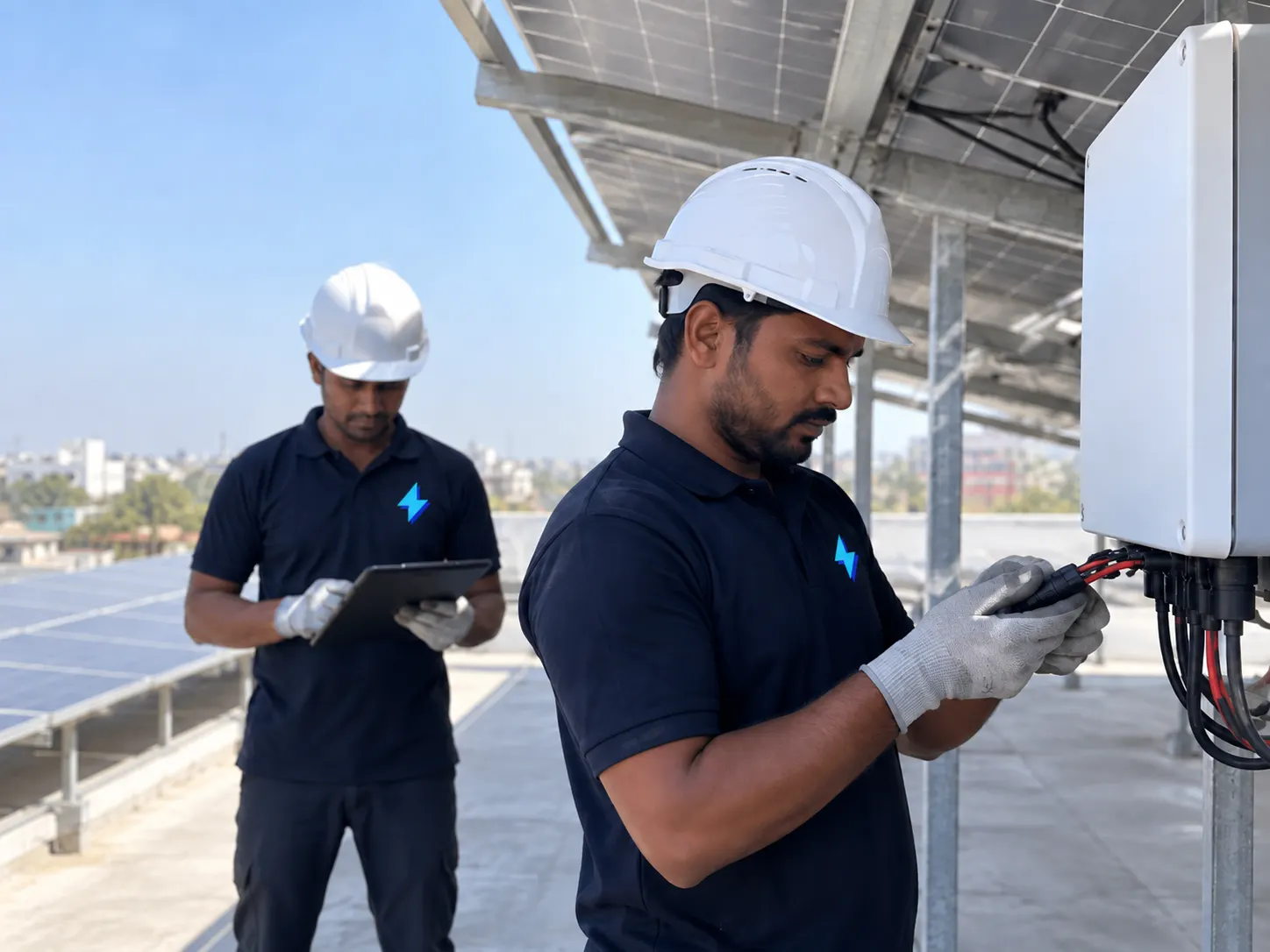


National capacity targets are announced in gigawatts and delivered in kilowatts. The rooftop share of India's 2030 commitment is the sum of a very large number of individually small decisions.
A rooftop system generates at the point of consumption. There is no transmission loss between the panel and the fan, and no additional network capacity required to deliver it. That makes distributed generation disproportionately useful per megawatt installed, and disproportionately difficult to aggregate.
Utility-scale plants are built by a few dozen developers signing a few hundred contracts. The rooftop segment requires millions of households to each run a survey, a subsidy application, a discom approval and an installation. That is the bottleneck, and it is an administrative one rather than a technical one.
Where our attention goes
Most of what RePrime builds is process, not hardware: the tracking, the paperwork and the milestone payments that make a small installation as reliable to execute as a large one.
The technology question was settled a decade ago. What remains is the paperwork, and paperwork is a solvable problem.
What to take away
Aditya Pandey
Policy & subsidy desk
Files subsidy packets and net-metering applications for RePrime customers across UP, Delhi and Haryana. Reads discom circulars so you do not have to.
Run these numbers against your own bill
The calculator uses state-wise generation data and the current subsidy slabs. Two inputs, one estimate, no call required.